
Frequently Asked Questions
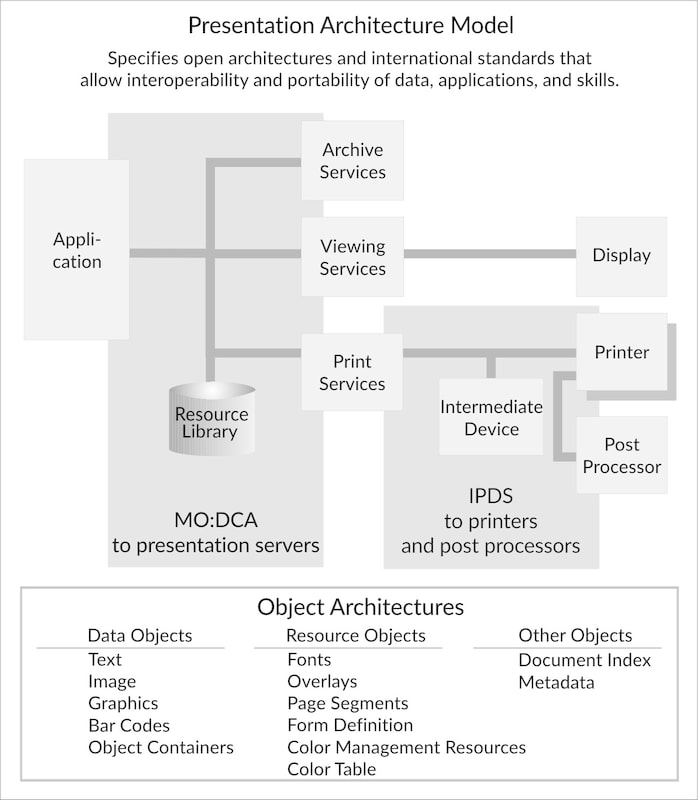
What is the AFP Consortium?AFP stands for Advanced Function Presentation and is a coordinated set of document creation, viewing, archiving and printing hardware, software and services. AFP defines native text, image, graphics and bar code objects that can be combined to create page content and provides a means for managing fonts, overlays and other resource objects such as ICC profiles for color management. AFP can encapsulate other standard document formats such as TIFF, JPEG and PDF. AFP documents may be indexed to facilitate navigation in viewing and reconfiguration for complex production workflow.
|
|
What does the AFP Consortium do?
The AFP Consortium facilitates open collaboration among a group of 32 companies who, at any point in time, are situated in some manner as partners and/or competitors in the marketplace. If you are an AFP hardware or software vendor, you can request membership information by going to the Contact Us page on this site. If you are an end-user of AFP, while not eligible for membership, the AFP Consortium certainly welcomes your perspective, so we invite you to share your thoughts with us via “Ask The Expert.”
AFP originated within IBM as a mainstream presentation architecture. In 2004, IBM invited companies from across the industry into a bilateral collaboration called the AFP Color Consortium. After successfully defining AFP CMOCA (Color Management Object Content Architecture), the role of this team expanded into other areas of AFP architecture. In 2009, the AFP Consortium (AFPC) was formally incorporated as a peer-based open standards organization with Core, Participating, Observer, and Associate member levels. The entire AFP architecture is now developed and maintained by the AFP Consortium.
Who uses AFP?
English
Français
Italiano
Deutsch
Español
Nederlands
日本
English
Français
Italiano
Deutsch
Español
Nederlands
日本
AFP is generated by applications in the insurance, banking and mission critical industries who need to insure reliable reproduction across the print and viewing environments and complete page integrity in the production environment.
For more detail about AFP and the benefits it brings, watch the next video: "Looking for the value of AFP?"
For more detail about AFP and the benefits it brings, watch the next video: "Looking for the value of AFP?"
Looking for the value of AFP?
English
Français
Italiano
Deutsch
Español
Nederlands
日本
English
Français
Italiano
Deutsch
Español
Nederlands
日本
What's the difference between AFP and PDF?
While PDF has its origins in the graphic arts and ubiquitous desktop viewing, the emphasis for AFP is very high speed variable data printing. Fundamental to AFP is built in job ticketing with the FormDef and the Intelligent Printer Data Stream (IPDS) which enables resource management, error recovery and consistent output across vendor products. However, as AFP grows and evolves, it is expanding its presence in the graphic arts and desktop viewing fields.
How do I get answers to technical questions about AFP?
If you have technical questions about AFP, there is now an AFP Forum where you can ask questions and get answers from other users who are knowledgeable about AFP. To join the conversation, register at afp-forums.org.
Please note: This is a moderated community platform, sponsored by the AFP Consortium. While the AFP Consortium sponsors this forum, the ideas and information exchanged are independent of the AFP Consortium and do not reflect the official policy or position of the AFP Consortium.
Please note: This is a moderated community platform, sponsored by the AFP Consortium. While the AFP Consortium sponsors this forum, the ideas and information exchanged are independent of the AFP Consortium and do not reflect the official policy or position of the AFP Consortium.


AFPC, AFP Consortium, and the AFP Consortium Logo are trademarks of the AFP Consortium.
© 2024 AFP Consortium. All Rights Reserved
© 2024 AFP Consortium. All Rights Reserved